
Overlap Is Real but Finite
Pakistan is nine hours ahead of US Eastern in summer, ten in winter. Your morning is our evening. That window is workable and it is not unlimited.
Skyline Grow works with businesses in the United States and operates from Lahore, Pakistan. That is the first thing worth saying plainly, because it is the thing most offshore agencies arrange their website to avoid saying. This page covers what the distance actually changes, what it does not, and the questions you should be asking any agency outside your country — including this one.
Four things are genuinely different. Everything else is the same work it would be from an office in your city.
Pakistan is nine hours ahead of US Eastern in summer, ten in winter. Your morning is our evening. That window is workable and it is not unlimited.
Not an account manager relaying your questions to a team you never meet. Whoever answers your email is working on the project, so nothing is lost being passed along.
Decisions get written down because they cannot always be resolved in a hallway. That is an advantage more often than a cost.
Jurisdiction, payment and recourse need to be agreed up front rather than assumed. A US client is right to ask about it.
This is arithmetic, not a promise. Pakistan Standard Time is UTC+5 and does not observe daylight saving, so the gap shifts by an hour when the US clocks change.
Ask About a Project →9am in New York is 6pm in Lahore. A morning call on your side is a normal evening on ours — the easiest overlap on the map.
9am in Chicago is 7pm in Lahore. Same picture, an hour later. Most of the working day has usable overlap.
9am in Denver is 8pm in Lahore. Still workable for scheduled calls, tighter for anything spontaneous.
9am in Los Angeles is 9pm in Lahore. Honest answer: this is the hardest one, and it means calls are scheduled rather than ad hoc.
The working arrangement, stated before you ask for it.
One named person who stays with the project from scope to handover, and who is close enough to the work to answer without going away to ask. Fewer people to chase, and nothing lost between what you asked for and what gets built.
Not a reply resolving everything, but an acknowledgement with a real answer or a stated time for one. Silence across a time-zone gap is the thing that erodes trust fastest, so we treat it as the thing to avoid.
Calls are booked into your working day rather than ours. For East Coast and Central clients that costs us nothing unusual; for Pacific clients it means evenings, and we plan around that rather than pretend it is not true.
Scope, changes and reasoning are written down as they happen. This exists because a question cannot always be settled in the next five minutes, and it turns out to be a better record than most co-located projects keep.
Source files, code and access transfer to you on completion and payment. Nothing is held hostage in an account you cannot log into — the terms covering this are on the terms page, not buried in a proposal.
Quoted in the currency you budget in, with scope defined before work begins. Indicative ranges are published on the pricing page rather than discovered during a call.
Analytics, Search Console, ad accounts and hosting stay in your ownership with us granted access. An agency that owns your accounts has leverage it should not have.
SEO, web development, web design, UI/UX, Google Ads, social media and branding — the same services list, delivered the same way regardless of where the client sits.
None of this is unique to working across a border — it is what any competent engagement should look like. It is written down here because distance removes the informal reassurance that proximity provides, and the gap has to be closed with something explicit instead.
Including us. These are the ones that separate an agency that has thought about the distance from one that is hoping you will not notice it.
Ask for the name. Plenty of offshore arrangements involve a salesperson you like and a delivery team you never speak to. If the answer is vague, that is the answer.
A specific window, not "we are flexible". Flexible usually means nobody has decided, which means it gets decided by whoever is awake when something breaks.
Analytics, Search Console, ad accounts, domain, hosting. If the agency owns them, changing agencies later means losing your history. The answer should be: you do.
Notice period, handover, what transfers and in what format. An agency confident in the work has a clean answer; one that does not will change the subject.
Cross-border contracts need this settled in writing. It is reasonable for a US client to want terms they can actually enforce, and reasonable to negotiate it rather than accept the first draft.
Monthly reports are easy to make look good. Ask why a decision was made, not just what the number did. Distance makes this more important, not less.
These come up in almost every first conversation. Dealing with them directly is cheaper than hoping they do not get asked.
It is usually the reason people start looking, and it is the wrong reason to choose. Cost differences across borders are real, but a cheap engagement that produces nothing is not cheap — it costs a quarter of the year as well as the fee.
The better reason is access to someone who will do the work themselves at a price that does not require a committee to approve. A US agency at a comparable price point is frequently a junior executing from a template; the same budget offshore can buy senior attention. That is the actual trade, and it is worth stating in those terms rather than as a discount.
What should not change is the standard. The work either moves the numbers or it does not, and geography is not a defense for work that does not.
Something breaking during your night is the case where distance helps rather than hurts. Your 2am is our mid-morning, which means a site going down overnight is noticed and addressed while you are asleep rather than discovered when you wake up.
The reverse case — something breaking at 3pm your time, which is midnight here — is the one worth planning for. That is handled the way it should be handled anywhere: knowing what can break, having access to fix it, and agreeing in advance what counts as urgent enough to wake someone for.
The honest position is that neither arrangement gives you a team on call around the clock, and any agency of this size that claims otherwise is describing something they have not staffed.
This is a fair question and the answer is in front of you. Every page on this site was written by the same person who would write yours, in US English, for a US reader. If this page reads naturally, that is the sample.
Where it genuinely matters is in the detail that signals local knowledge — how prices are discussed, which platforms are assumed, what a reader takes for granted. Those are learnable, and the test is whether the writing shows it rather than whether a byline claims it.
Where it does not matter is grammar and tone, which is where most of the worry sits. The blog is twenty-plus posts long and is the easiest way to judge this before committing to anything.
Invoiced in US dollars against agreed milestones or a monthly retainer, with the scope for each written down before it starts. International transfer carries fees and takes longer than a domestic one, which is worth factoring into timing rather than discovering at the first invoice.
What matters more than the mechanism is the structure. Milestone-based payment protects both sides: you are not paying for work that has not happened, and we are not carrying a quarter of unpaid delivery. For ongoing work a monthly cycle with a clear notice period does the same job.
The specifics — method, schedule, currency handling and what happens on a late or disputed invoice — belong in the agreement rather than on a web page, and we put them there.
Because that is where the business is, and the structured data on every page of this site says so. Claiming a US address we do not have would be a lie told to a search engine as well as to you, and it is the kind that gets found.
A number of offshore agencies rent a virtual US address and list it as an office. It is a short-term trick that creates a long-term problem: the entity Google builds for the business contradicts itself, and a client who discovers it reasonably wonders what else was arranged for appearances.
The version that holds up is the plain one. Based in Lahore, working with US businesses, with the time zones and the working arrangement written out above so you can decide whether it suits you.
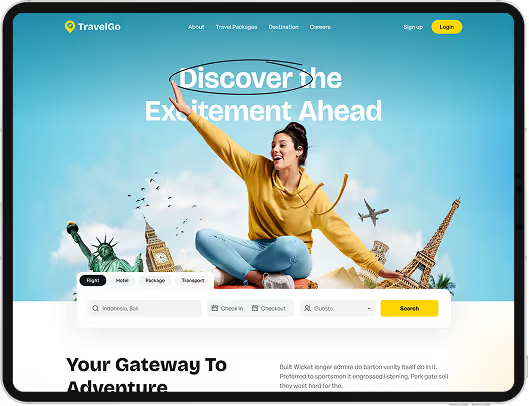
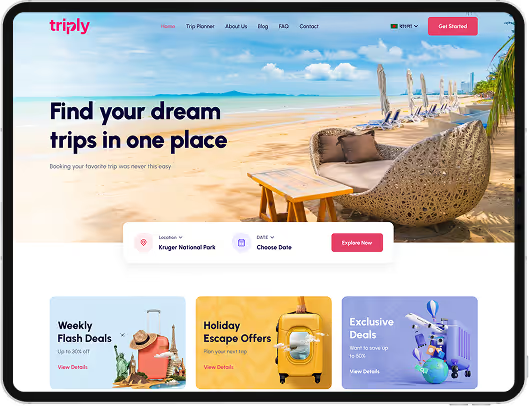
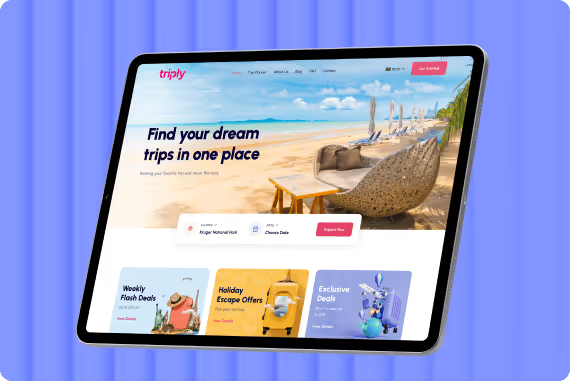
A rebuilt website paired with a sharper SEO and content strategy turned this travel brand's search traffic into real bookings.

Skyline Grow CEO
Local SEO services plus targeted social content put this restaurant at the top of local search and on more phones than ever.
Skyline Grow CEO
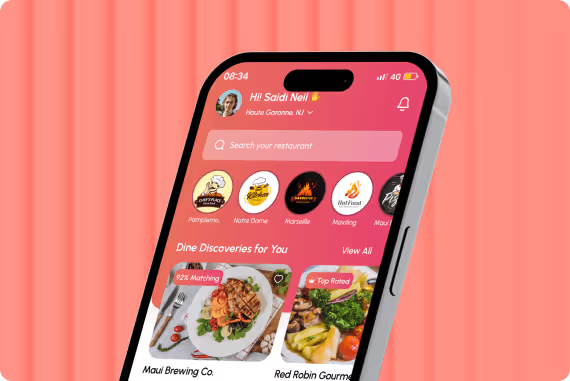
A full technical SEO overhaul and new website design helped this real estate brand outrank bigger, better-funded competitors.
Skyline Grow CEO
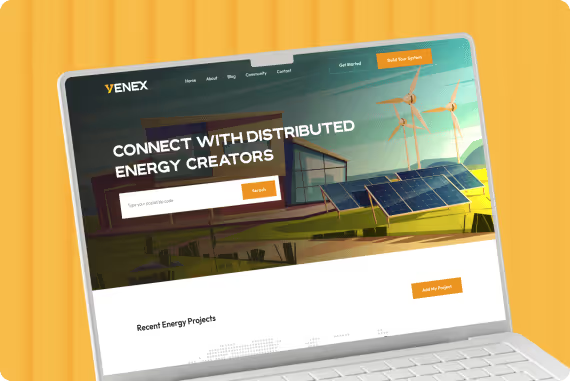
Website development, local SEO, and Google Ads management working together to get a fitness brand found by the right people.
Skyline Grow CEO
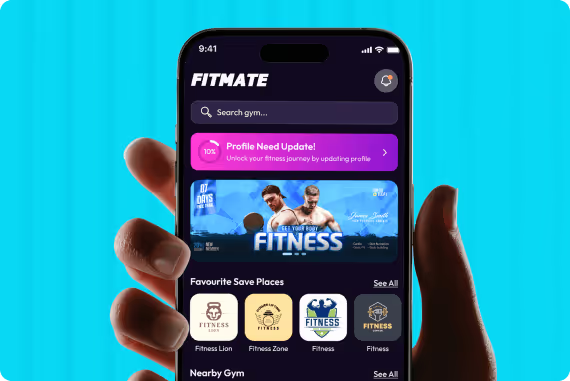
A complete website optimization and PPC advertising strategy that put this vehicle service brand in front of ready-to-book customers.
Skyline Grow CEO
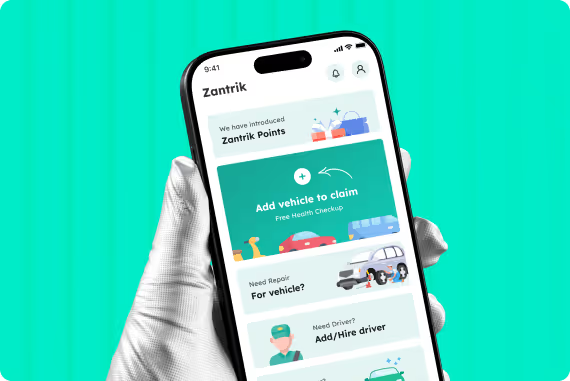
Lahore, Pakistan. We work with businesses in the United States, and the structured data on every page of this site states both — the location of the business and the market it serves.
Pakistan Standard Time, UTC+5, with no daylight saving. That is nine hours ahead of US Eastern during your summer and ten during your winter, so 9am in New York is 6pm in Lahore.
Yes, and that is how they are scheduled. East Coast and Central mornings fall in our evening, which is straightforward. Pacific mornings fall late in our evening, which is workable for booked calls rather than spontaneous ones.
The team doing the work, through one named point of contact who stays with the project throughout. There is no account manager layer passing messages back and forth. About us covers who we are.
Within 24 hours. Not necessarily with a complete answer, but with an acknowledgement and either a real response or a stated time for one.
You do. Analytics, Search Console, ad accounts, domain and hosting stay in your ownership with access granted to us, and source files and code transfer on completion and payment.
US dollars. Indicative starting points are published on the pricing page, and anything specific is quoted against a defined scope before work begins.
The honest answer is that this is a young business — founded in 2025 — and we would rather you judge it on the work you can see than on a client list. The blog and the service pages are the sample.
It carries risks a domestic engagement does not, mostly around recourse and accountability. They are managed with written scope, milestone payments, your ownership of accounts, and a clean exit path — all of which are reasonable to insist on.
It is agreed in writing before work starts rather than assumed. A US client may not want to accept Pakistani jurisdiction in a services agreement, and that is a fair position to negotiate from. Our terms cover the website; project work has its own agreement.
Still deciding if for us businesses is right for you?
Talk to UsLook at enough offshore agency websites and a pattern appears. A stock photograph of a city skyline that is not theirs. A map pin in a country they do not operate from. Team photographs that reverse-image-search to a licensing library. A client logo wall nobody can verify.
None of that is there because the work is bad. It is there because the sales advice is that a US buyer will not enquire if they know, so the location gets arranged out of view and the conversation happens before the question comes up.
The problem is what it costs when the buyer finds out, which they usually do, at the point where trust matters most. An agency that was vague about where it sits has taught the client to wonder what else was presented carefully rather than honestly.
So this page states it at the top instead. Based in Lahore, nine hours ahead of New York, working with US businesses, with one point of contact who stays on the project. If the distance is the wrong fit for how you want to work, better to establish that now than four weeks into a project. And if it is not, the rest of the decision is the same one you would make about any agency: look at the work and ask the hard questions.
Tell us what you are trying to move and where you are based. We will tell you honestly whether the overlap works for how you want to run the project.