
Real People
Named, with photographs and roles. It is the most checked thing on the page.
The about page is one of the most visited pages on most sites, and it is usually written about values rather than people. About page design should answer the questions visitors are actually there for: who does the work, how long you have been doing it, where you are, and whether you look like a business worth trusting with a decision.
People visit an about page to check something specific, not to read a mission statement.
Named, with photographs and roles. It is the most checked thing on the page.
Founded when, based where, what you do. Not adjectives.
Nothing about scale, awards or milestones that is not true.
Where you actually are, which is checked more than most businesses expect.
Because this page is often the one before contact.
An about page is read by people deciding whether to trust the business, not by people interested in its history. These checks test whether it reduces perceived risk.
The last row is where most about pages carry risk. Years of experience, client counts and team sizes are frequently written once and never revisited, and a claim that cannot be evidenced is a liability in exactly the conversations that matter. Anything stated here should be confirmed by the business — OWNER VERIFICATION REQUIRED.
Four checks, and none of them is your values.
Discuss Your About Page →A registered business with people and an address.
Named individuals rather than a stock photograph of a meeting.
Experience, stated factually.
Checked more often than most businesses expect, and often decisive.
The facts, the people, and a route onward.
For professional services, this pairs with law firm and financial website design. The credentials this page presents come out of brand strategy; the organization markup on it is part of technical SEO.
Establish the facts worth stating, then present them in the order people check.
What is true and verifiable about the business.
In the order visitors check them.
Named, with roles and real photographs.
Organization data for search.
To contact or services.
What an about page needs to do depends on what a prospective client is worried about, and that varies more than the page format suggests.
Where the buyer is assessing whether the business will still exist and can handle the work. Being specific about capability and how work is delivered does more than implying scale the company does not have.
Consultancies, agencies and professional services, where the buyer is choosing individuals. Named people with genuine relevant experience carry the page; anonymity actively works against it.
Where there is little history to point to. The honest approach is describing capability, method and the problems the business solves rather than manufacturing a track record. Specificity substitutes for tenure better than vagueness does.
Where a prospect wants to know the business understands their world. Demonstrating familiarity with the actual problems of that sector is more convincing than claiming to serve it.
Where the about page still describes a company that no longer exists in that form. This is common and quietly damaging, because it contradicts the service pages and reads as neglect.
They are unfalsifiable, and unfalsifiable claims carry no information.
No business claims otherwise, so the statement distinguishes nothing. A reader cannot use it to compare you with anyone.
It also occupies the space where a verifiable fact could sit — founded in a particular year, a named person with a specific background, a location.
Facts do the work values statements are meant to do. A named team with real photographs signals more about reliability than any adjective.
Because it establishes that the business is real and locatable, and for many buyers it also affects the decision — time zone, jurisdiction, whether a meeting is possible.
Sites that avoid stating a location invite the conclusion that there is a reason for the avoidance, which is rarely the impression intended.
Where the honest answer is that the business operates remotely or serves a region rather than a place, saying that plainly is better than saying nothing.
Visitors reach this page for one reason: they are considering working with the business and want to know whether that is a risk. They are not interested in the founding story for its own sake, and a page organized as a chronology answers a question nobody asked.
What they are looking for is narrower — who these people are, whether they have done this kind of work, how the engagement runs, and whether anything here suggests a bad experience. A page organized around those questions serves the actual reader.
This reorders the page. The history, where it matters, matters because it evidences capability rather than because it is interesting. Leading with it delays the information the visitor came for, and many will not scroll far enough to reach it.
About pages default to language every competitor could use: passionate, dedicated, results-driven, client-focused. None of it distinguishes anything, because no business describes itself as the opposite, and a reader discounts the whole passage rather than any individual phrase.
What carries weight is anything checkable. The kind of work actually done, the sectors genuinely served, how a project is structured, who does what. These are less flattering and considerably more persuasive, because they give the reader something to evaluate.
The same discipline applies to numbers. A figure with nothing behind it is worse than no figure, because it invites a question the business may not be able to answer. Where a claim cannot be evidenced, it should not be made — and where it can, saying what it is based on strengthens it.
This page rarely creates interest and frequently confirms or destroys it. A visitor arrives from a service page already considering the business, and the about page either supports that or introduces doubt.
That makes its main failure mode passive rather than active: not saying anything wrong, but saying nothing that helps. A page of generic reassurance leaves the visitor exactly where they were, having spent attention on nothing.
It also means the page should route onward rather than terminate. Someone who has just been reassured is at a good moment to act, and the page should offer that — either directly to contact or back into the web design service they were reading about, rather than leaving them to find their own way.

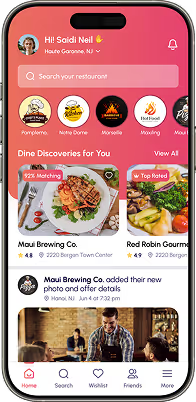
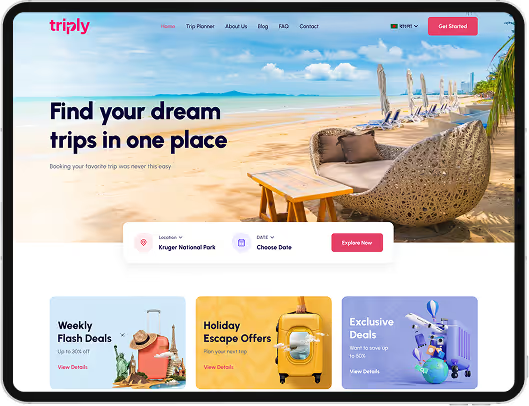
About page design structures the page around what visitors actually check — who the people are, what the business is, where it is based, and how long it has done this work.
Real ones, yes. Named people with photographs and roles are the most checked element on the page and signal more about reliability than any values statement.
Because no business claims the opposite, so the statement distinguishes nothing. Verifiable facts do the work values statements are meant to do.
Yes, and plainly. Avoiding it invites the conclusion that there is a reason. Where you operate remotely or serve a region, saying that is better than saying nothing.
It carries the organization details worth marking up, and it is often the page where business identity is established. It is rarely a ranking page in itself.
Where the people are part of what is being bought, yes — real photographs of actual staff do more for trust than any wording. Stock photography standing in for a team is usually recognisable and undermines the page. If real photos are not available, naming people without images is better than using someone else's.
Only what evidences capability. Founding dates and milestones matter to the founders and rarely to a prospect, who is trying to work out whether you can do their work. Where history demonstrates relevant experience, it earns its place; where it is a timeline, it is displacing something more useful.
Say so and be specific about what that means for the client — direct access to the people doing the work, fewer handovers, faster decisions. Implying scale you do not have is discovered quickly and costs more than the size ever would. Buyers who need a large supplier will not be won by ambiguity.
Only if they are specific enough to be false of a competitor. Statements about integrity and excellence are read as filler because every business claims them. A genuine operating principle — something the business does differently and could be held to — is worth stating; a values list rarely is.
Whenever the business changes materially: people join or leave, the offer shifts, the audience changes. About pages are written once and forgotten more often than any other page, and an out-of-date one contradicts the rest of the site — which reads as neglect rather than as an oversight.
Still deciding if about page design is right for you?
Talk to UsAbout pages fill up with values: integrity, quality, putting the customer first, a passion for the work. Each is written sincerely and each is true.
None of it is usable, because no competitor claims the opposite. A reader comparing three suppliers reads the same values three times and learns nothing that separates them.
What separates them is a named person with a real background, a year the business started, and a place it operates from — the things that can be checked, and which most about pages leave out to make room for the values.
Send us your about page. We will tell you what a visitor can verify from it and what is taking up space without saying anything.