
Menu as HTML
Readable on a phone, indexable, and updatable without a designer.
Nearly everyone arriving at a restaurant site wants one of four things: the menu, the opening hours, a table, or directions. Restaurant website design should deliver all four within a tap on a phone — and the single most valuable change most restaurant sites can make is turning a PDF menu into a page.
A PDF menu is the most common and most costly mistake on a restaurant site.
Readable on a phone, indexable, and updatable without a designer.
Including holidays, which is when people check and get it wrong.
Whether that is your system or a phone number.
Address, map and parking, without hunting.
Because these visits happen outside, on mobile data, in a hurry.
Four tasks, and they should each take seconds.
Discuss Your Site →The most common reason to visit. It has to be readable on a phone.
Especially today and holidays. Wrong hours cost real custom.
One tap to your system or your number.
Address, map, parking, nearest transport.
The four tasks, done properly, on a phone.
Local visibility is covered by local SEO. Reservation flows are booking website design; hours, location and profile consistency are local SEO.
Four tasks, each measured in taps.
Sections, items and prices as pages rather than a document.
Because that is where the visit happens.
Your system, or a number that taps to call.
Hours, location, parking, accessibility.
So menu changes do not need us.
It is convenient to produce and hostile to use, and it is invisible to search.
It downloads, opens in a separate viewer, and arrives at a size designed for A4 paper. The reader pinches and drags through a document laid out for a printed page.
A proportion give up, and giving up means choosing a different restaurant — the decision they were making when they opened the menu.
A menu as HTML pages reflows to the screen, loads instantly, and can be read while walking. It is more work to set up once and considerably less work to update afterwards.
Dish names are searched. So are dietary terms — gluten free, vegan — alongside a location. A PDF is poor material for that, and the words inside it are effectively unavailable to the pages people would land on.
A menu as pages makes every dish and dietary category part of the site's content, which is a substantial amount of specific, locally relevant text.
For a restaurant, that is often the largest single body of searchable content the business has, and it is routinely locked inside a document.
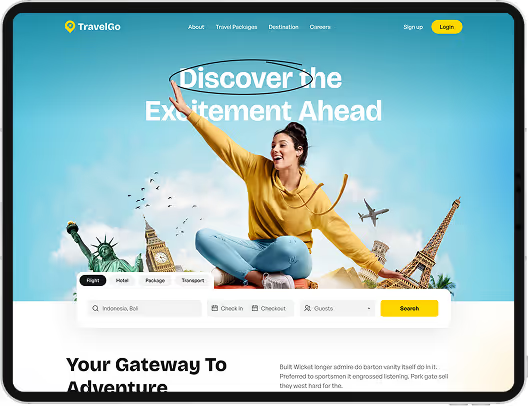
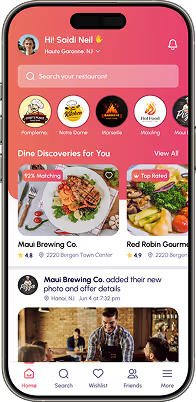
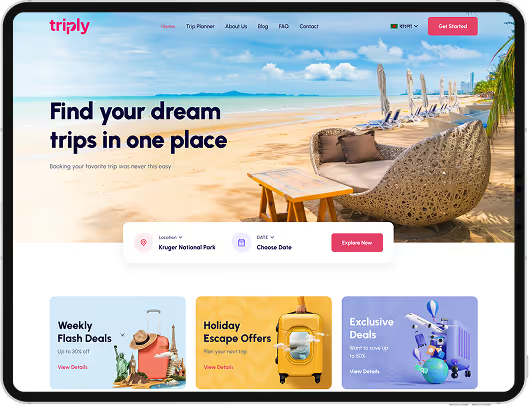
Restaurant website design builds sites around the four things visitors want — menu, hours, booking and location — delivered quickly on a phone, with the menu as readable pages rather than a PDF.
Because it downloads, opens separately and is laid out for paper, so reading it on a phone means pinching and dragging. A proportion of visitors give up, and giving up means choosing elsewhere.
Where you take reservations, an integration with your existing system is worth having. Where you do not, a tappable phone number in a fixed position does the job — see booking website design.
Very, and holiday hours especially. People check hours immediately before traveling, and wrong information on the site costs a visit and often a customer.
Worth having and worth sizing properly — food images are large and they dominate the page weight, which matters when the visit happens on mobile data outside.
Still deciding if restaurant website design is right for you?
Talk to UsRestaurant websites get reviewed on a laptop by people who already know the menu, at a moment when nothing is at stake.
They get used by someone standing on a street deciding where to eat in the next ten minutes, on a phone, with a group waiting on an answer.
A menu that downloads as a document and arrives at paper size loses that decision to whoever put theirs on a page. Nothing else about the site can compensate for it.
Send us your site. We will open it on a phone and time how long it takes to read the menu, check today's hours and book a table.