
Message Continuity
The page repeats the ad's promise in its first line.
A paid click arrives with an expectation the ad created. If the page restarts the conversation — a general homepage, a different offer, a broader message — the click is wasted before design, speed or persuasion matter. PPC landing page design is mostly the work of continuing the ad rather than beginning again.
The most expensive landing page problem is a mismatch nobody checked.
The page repeats the ad's promise in its first line.
A landing page with four options is a homepage.
Because a paid visitor has less patience than an organic one.
A slow paid page loses a click you already bought.
So the page and the ad can be judged separately.
Every visitor to a paid landing page cost money, which changes the arithmetic of every design decision. These checks test whether the page honours the promise that was paid for.
Tracking integrity underpins everything else. A page optimized against inaccurate conversion data is optimized toward the wrong thing, and duplicate or missing conversions are common enough that verifying the measurement should precede any change to the page.
Four differences from an organic visit, and each changes the design.
Discuss Your Landing Pages →The ad made a specific promise. The page has to meet it immediately.
A paid visitor did not choose you from results. They clicked one thing.
Every bounce has a cost attached, which changes the tolerance for friction.
The ad targeted one thing. The page should serve that one thing.
Match, focus, speed and measurement.
Campaign-side work is covered by landing page optimization. Campaign-side work is landing page optimization; measurement per campaign depends on conversion tracking.
Read the ads first. The page is a continuation of them.
What was promised, per ad group.
The page's first line meets that promise.
Everything else removed.
Briefly, in the order they arise.
Per campaign, one change at a time.
Landing page requirements follow from the offer and the traffic. A page built for one campaign shape performs poorly for another.
Where the goal is an enquiry now. Form design, offer clarity and objection handling determine performance, and every element not supporting the single action is competing with it.
Where nobody commits from a single visit. The realistic goal is a smaller step — a call, a consultation, a resource — rather than a full enquiry, and pages asking for too much convert nobody.
Where the landing page is a product or category page and the question is whether it matches the ad. Sending a specific-product ad to a general category page is the most common wasted spend in retail search.
Where one page serves queries with different intent. Message match degrades as the page tries to cover everything, and separate pages per intent group usually outperform one general page.
The clearest signal that the landing experience does not match the promise. This is a page problem rather than a campaign problem, and more budget will not fix it.
It is designed to route many intents, and a paid click has exactly one.
The visitor arrives expecting the specific thing the ad described and finds a page addressing everything the business does. They have to search for what they came for.
A proportion do not, and the click is lost — a click that was paid for, on a keyword chosen precisely because it signalled that specific intent.
It also affects campaign economics beyond the bounce, because relevance between the ad and the page is part of how paid platforms assess quality.
Because the ad targeted one intent, and offering four routes reintroduces a decision the visitor had already made by clicking.
A landing page with a form, a phone number, a newsletter signup, a downloadable guide and a link to services is a homepage with a headline.
Removing the alternatives is uncomfortable — each one converts somebody — and it is usually the single change that most improves what a paid page does.
A visitor clicks an ad because it said something specific. If the page does not immediately confirm they are in the right place — using the same language, addressing the same thing — a share of them leave within seconds, and every one of those was paid for.
The failure is usually structural rather than careless. A campaign runs several ad groups and points all of them at one general page, so the specific promise in each ad is answered by generic copy. The page is not wrong; it is just not about what was advertised.
The fix is more pages rather than better copy on one. A page per intent group, echoing the ad's language in the heading, is the single most reliable improvement available in paid search — and it is cheap compared with the spend it protects.
Landing page advice frequently says to strip navigation entirely. The reasoning is sound — every link away from the action is a route to not converting — and applied without judgement it costs more than it saves.
For a low-commitment offer with a short form, a focused page with minimal exits works well. For a high-value service where the visitor reasonably wants to know who the business is before making contact, removing every route to that information produces a page that feels evasive.
The practical middle is to keep the primary action unmistakably dominant while allowing the small number of paths a genuine buyer needs. What should be removed is incidental navigation — blog links, unrelated services, footer menus — rather than everything that is not the form.
Form length should be proportionate to what the visitor gets. A short guide asking for a name and email is a fair exchange. The same guide asking for company size, budget and phone number is not, and the abandonment reflects that rather than a design flaw.
This runs the other way too. A page offering a detailed consultation on a complex service can reasonably ask more, because the visitor understands why the information is needed and the exchange is proportionate.
Where qualification genuinely matters, the honest approach is to say why the information is being collected. A short line explaining that a question helps route the enquiry costs nothing and recovers a meaningful share of the people who would otherwise stop at it.
Landing page performance and campaign performance are frequently treated as separate concerns owned by different people. They are one system: relevance between query, ad and page affects both what the click costs and what it produces.
This means diagnosis has to cross the boundary. A page converting poorly may be receiving traffic from queries it was never built to serve, which is a targeting decision rather than a design one — and redesigning the page will not fix it.
Getting that right means the PPC work and the page work are scoped together rather than sequentially, and it is why paid landing pages sit slightly apart from the rest of web design as a discipline.
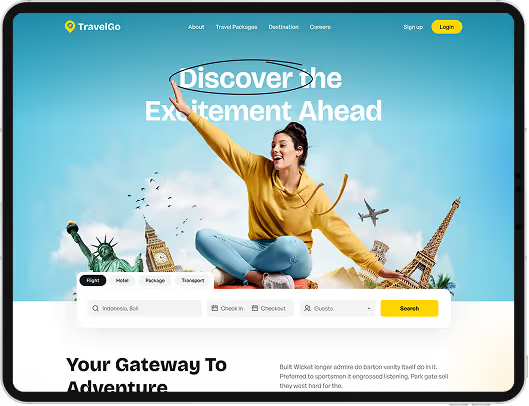
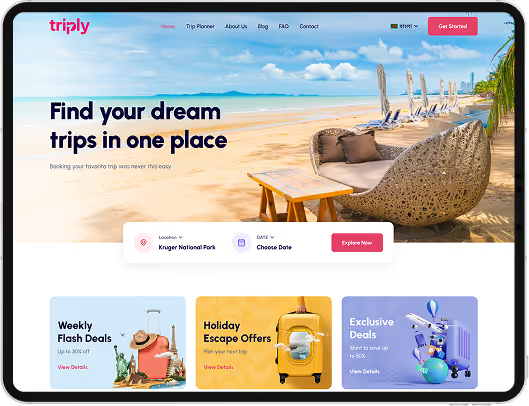
PPC landing page design builds pages for paid traffic that continue the promise made by the ad, offer one action, and are measured per campaign so the page and the ad can be judged separately.
You can, and it usually wastes clicks. The homepage routes many intents; a paid click has one, chosen deliberately by the keyword. The visitor has to search for what they came for.
One. A page with a form, a phone number, a newsletter signup and a services link is a homepage with a headline, and it reintroduces a decision the click already made.
Closely enough that the first line of the page repeats the promise of the ad. Message continuity is the difference between a click that continues and one that restarts.
One change at a time, with enough volume to distinguish a result from noise, measured per campaign — see conversion rate optimization.
Scope. Landing page design covers any page built for a single action, whatever sends the traffic — an email, a social post, an organic result. This page is the paid-traffic case specifically, where the ad has already made a promise the page has to continue and where measurement runs per campaign.
It depends on the commitment being asked. Low-commitment offers do well with minimal exits. High-value services where a visitor reasonably wants to check who the business is are hurt by removing every route to that. Keep the primary action dominant and allow the few paths a genuine buyer needs.
Roughly one per distinct intent group rather than one per campaign. Message match degrades as a page tries to serve queries that want different things, and separate pages usually outperform one general page by enough to justify building them.
Sometimes, and it is worth testing rather than assuming either way. A well-built service page that matches the ad closely can perform well. Where the ad makes a specific offer the service page does not mention, a dedicated page almost always does better.
Long enough to answer what stops people converting. Low-commitment offers need little; high-value services usually need more, because the objections are real and unaddressed objections end the visit. Length should follow the questions, not a template.
No honest number can be given in advance — it depends on the offer, the traffic, the industry and the commitment involved. Published benchmarks describe other people's campaigns. What matters is your own baseline and whether changes move it, measured in your own analytics.
Still deciding if ppc landing page design is right for you?
Talk to UsOrganic and paid bounces feel the same in an analytics report. Both are a visitor who arrived and left, recorded identically.
One of them cost nothing. The other was purchased, on a keyword selected because it signalled a specific intent, at a price set by an auction against competitors who wanted the same person.
Sending that click to a page that does not continue what the ad promised discards the most expensive part of the transaction at the exact moment it was won.
Send us your campaigns and the pages they point at. We will check message continuity and tell you where paid clicks are being wasted.